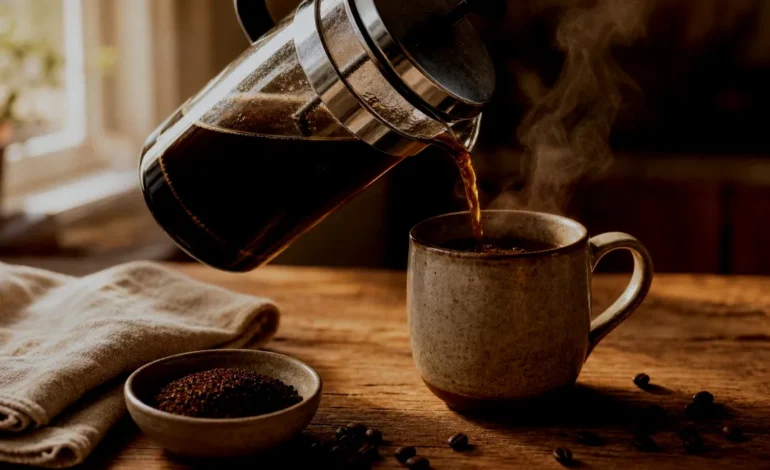
Few things in the coffee world are as simple — and as rewarding — as a French press. With nothing more than ground coffee, hot water, and four minutes of your time, you can brew a cup that tastes richer, fuller, and more flavorful than most automatic drip machines can manage. No paper filters, no plastic pods, no complicated settings. Just coffee, water, and a simple stainless-steel mesh.
Yet despite its simplicity, the French press has a reputation for being tricky. Some people end up with muddy, bitter sludge. Others get weak, watery coffee that tastes like brown water. The difference between the two is not luck — it is a handful of small choices you make before and during the brew.
In this guide, you will learn exactly how to prepare coffee using a French press, step by step. We will cover the tools you need, the ideal coffee-to-water ratio, the correct grind size, a precise brewing timeline, and the most common mistakes — and how to avoid every single one of them. By the time you finish reading, you will be able to brew a consistently excellent cup of French press coffee at home.
Why Use a French Press?
Before we dive into the method, it helps to understand why the French press produces coffee that tastes different from other brewers.
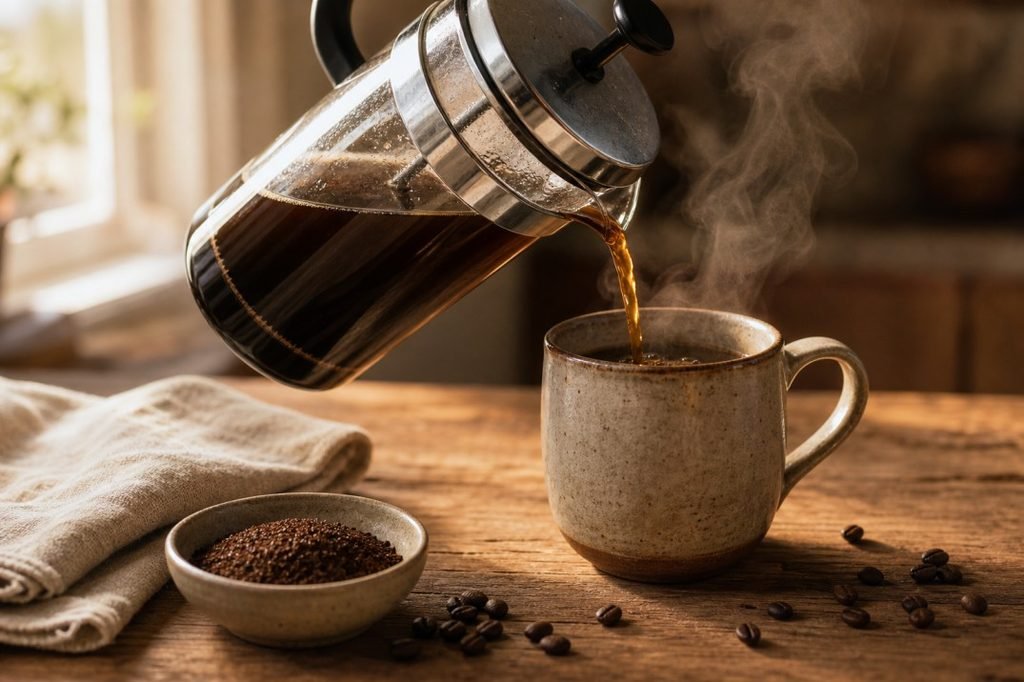
Full immersion brewing. In a French press, the coffee grounds sit in direct contact with the water for the entire brewing time. This is called full immersion, and it extracts flavor more evenly than drip coffee, where water flows through the grounds once and moves on.
Richer body. The metal mesh filter lets the natural oils and fine particles of the coffee pass through into your cup. These oils carry much of the flavor and aroma, which is why French press coffee feels thicker, silkier, and more substantial on the tongue.
No paper filter needed. Paper filters absorb coffee oils and some of the flavor compounds. The French press uses a reusable metal filter, so every bit of the coffee’s character makes it into your cup.
Simple and affordable. A quality French press costs far less than a fancy espresso machine, needs no electricity, and is easy to take camping or traveling.
Full control. You control the ratio, the grind, the water temperature, and the steeping time. Every variable is in your hands.
What You Need Before You Start?
The beauty of the French press is that the equipment list is short. Here is everything you need, from the essentials to the nice-to-haves:
| Item | Essential? | Why you need it |
| French press (any size) | Yes | A 1-liter press makes about 3–4 cups of coffee |
| Coarse-ground coffee | Yes | Ground coffee, or whole beans plus a grinder |
| Hot water (195–205°F / 90–96°C) | Yes | Just off the boil — boiling water burns the coffee |
| A timer or clock | Yes | Precise steeping time gives consistent results |
| A digital scale | Recommended | Weighing coffee and water removes all guesswork |
| A spoon (wooden or plastic) | Recommended | Stirring the grounds for even extraction |
| A kettle | Recommended | A gooseneck kettle pours with control, but any kettle works |
| A mug or carafe | Yes | For serving your finished coffee |
That is the whole list. If you have a French press and some coarse-ground coffee, you can start right now.
The Golden Ratio: How Much Coffee and Water?
The single biggest factor in how your French press coffee tastes is the coffee-to-water ratio. Too little coffee and you get weak, thin coffee. Too much and you get a bitter, overpowering cup.
The standard starting point for French press coffee is 1:15 — one part coffee to fifteen parts water by weight. This produces a balanced, medium-strength cup. If you prefer a stronger brew, move toward 1:12. If you like it milder, try 1:17.
Here is a quick reference chart for the most common press sizes:
| French Press Size | Water | Coffee (grams) | Coffee (tablespoons) |
| 350 ml (small) | 350 g / 12 oz | 23 g | ~4.5 tbsp |
| 500 ml (medium) | 500 g / 17 oz | 33 g | ~6.5 tbsp |
| 1 liter (standard) | 1000 g / 34 oz | 67 g | ~13 tbsp |
| 1.5 liters (large) | 1500 g / 50 oz | 100 g | ~20 tbsp |
Two important notes:
- Use grams, not cups. Measuring by weight is far more accurate than measuring by volume, because a “tablespoon” of coffee can vary in weight depending on the grind. A digital scale costs very little and is the single best upgrade you can make to your coffee routine.
- One tablespoon of coffee (level) weighs about 5 grams. So for a standard 1-liter press, you need roughly 13 tablespoons of coffee. If you do not have a scale, start there and adjust to taste.
Grind Size: The Most Common French Press Mistake
If there is one mistake that ruins more French press coffee than any other, it is using the wrong grind size.
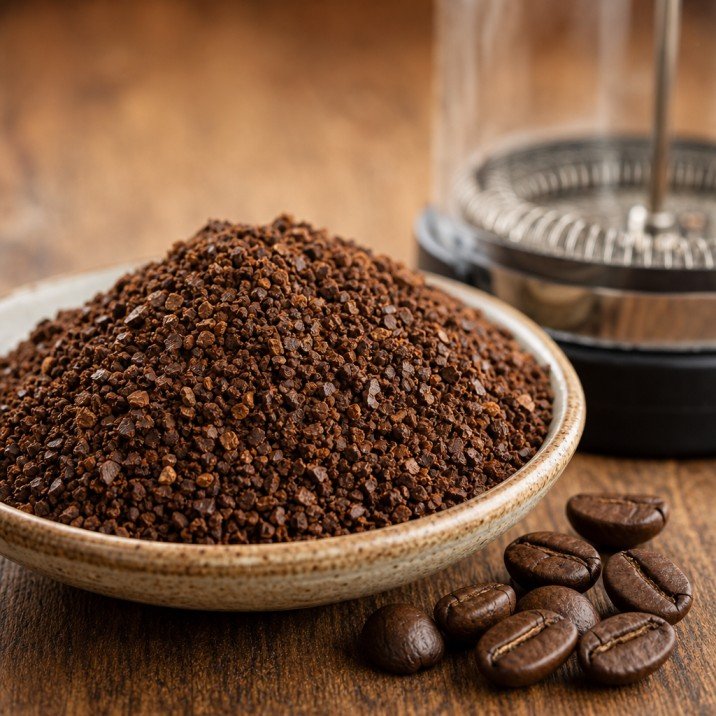
A French press needs coarse ground coffee — about the size of sea salt or breadcrumbs. The metal mesh filter is generous compared to paper, so fine coffee slips through and makes your cup gritty and muddy. Fine grounds also over-extract quickly, turning the coffee bitter.
Here is how French press grind compares to other brewing methods:
| Brewing Method | Grind Size | Looks Like |
| Espresso | Extra fine | Powder / flour |
| Pour-over (V60) | Medium-fine | Fine sand |
| Drip machine | Medium | Granulated sugar |
| French press | Coarse | Sea salt / breadcrumbs |
| Cold brew | Extra coarse | Rock salt / peppercorn pieces |
Buy ground coffee? Ask for the “French press” or “coarse” setting at the store or cafe. Grind at home? Set your burr grinder to a coarse setting (usually 8–10 out of 10 on the dial) or pulse a blade grinder in short bursts, being careful not to over-grind.
Rule of thumb: You should be able to see the individual coffee particles clearly. If your coffee looks like powder, it is too fine for the press.
Step-by-Step: How to Prepare Coffee Using a French Press
Now for the main event. Follow these eight steps and you will brew a clean, rich, full-bodied cup every single time.
Step 1: Preheat Your Press and Mug
Start with hot water. Rinse the French press carafe with hot water to warm the glass, and pour a little hot water into your mug as well. Cold glass steals heat from your brew, which makes the coffee extract more slowly and taste flat. Discard the water before brewing. This one small step makes a measurable difference in the temperature of your final cup.
Step 2: Add Your Coffee Grounds
Weigh out your coffee — remember, about 67 grams (13 tablespoons) for a 1-liter press, or adjust for your press size. Add the coarse grounds to the empty carafe.
Step 3: Pour the Hot Water
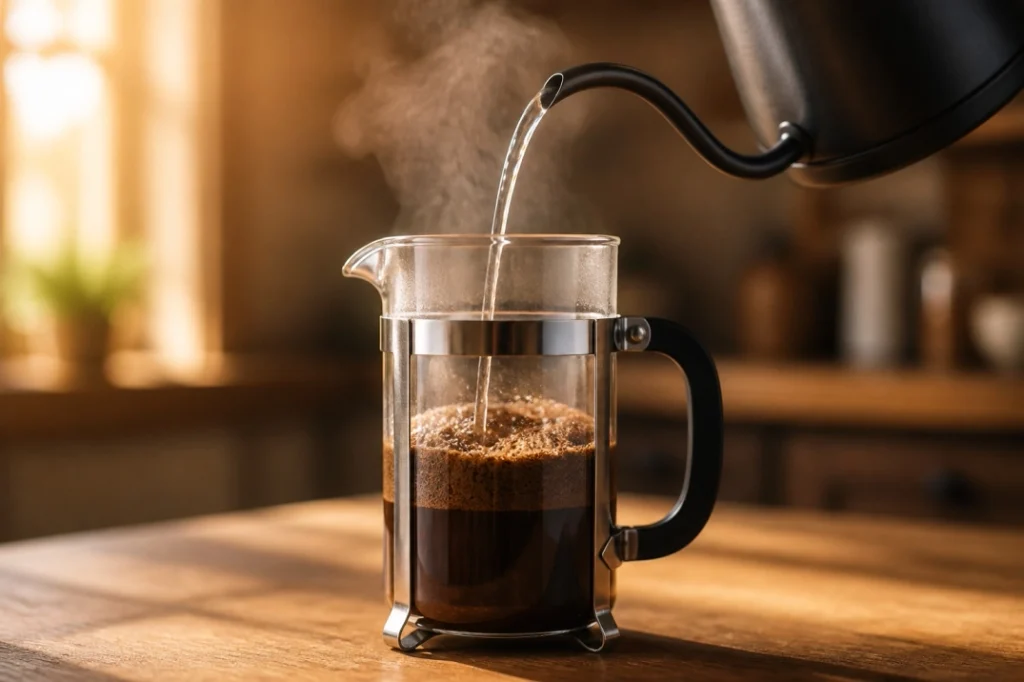
Heat your water to just off the boil — between 195°F and 205°F (90–96°C). If you are boiling water in a kettle, let it sit for about 30 seconds after it boils before pouring. Boiling water scorches the coffee and produces a bitter, burnt taste.
Pour the water slowly over the grounds until the carafe is full. A gentle, even pour ensures all the grounds get saturated.
Step 4: Stir Gently
Take your spoon and give the grounds a gentle stir to make sure they are fully saturated. Dry grounds floating on top will not extract properly, leaving your coffee tasting weak and uneven. Stirring also helps release the bloom — the pleasant bubbling and aroma that happens when coffee meets hot water. Important: use a wooden or plastic spoon. Metal spoons can crack the glass carafe.
Step 5: Steep for 4 Minutes
Set your timer for 4 minutes and let the coffee steep undisturbed. During this time, the grounds sink to the bottom and the water pulls out the flavor. Resist the urge to stir again — you want a clean, settled bed of grounds.
A useful tip: after about 30 seconds, skim off the layer of foam and floating grounds with your spoon. This simple habit removes the fines that cause a muddy cup.
Step 6: Plunge Slowly
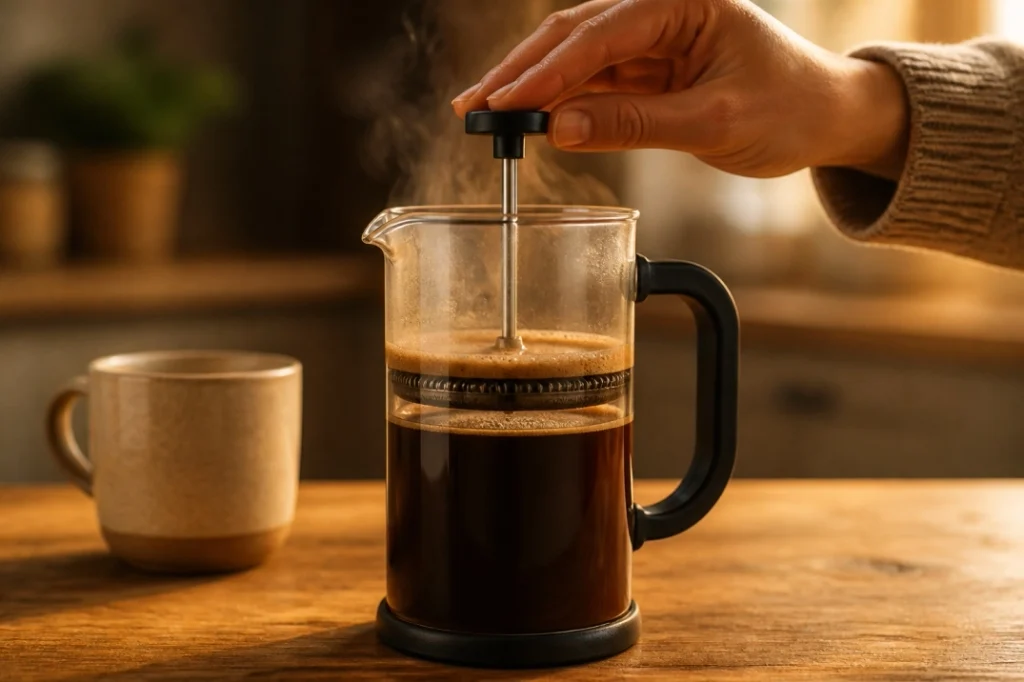
After 4 minutes, place the lid on the press and push the plunger down slowly and steadily. This step should take about 20 to 30 seconds. If you push fast, the pressure stirs up the fine grounds at the bottom and you end up with sludge in your cup. A slow plunge separates the brewed coffee from the grounds cleanly.
Step 7: Pour Immediately
Here is a rule many people forget: pour the coffee right away. If you leave the brewed coffee sitting on the grounds, extraction continues and your coffee turns bitter. Pour all the coffee into your mug or a separate carafe as soon as you finish plunging.
If you are brewing for several people and cannot serve it all at once, pour the coffee into a pre-warmed carafe (or individual mugs) rather than leaving it in the press.
Step 8: Enjoy — and Adjust to Taste
Your first cup is a starting point. Taste it and adjust next time:
- Too weak? Use more coffee or a slightly finer grind (but still coarse).
- Too strong or bitter? Use less coffee, a coarser grind, or a shorter steep time.
- Not sweet enough? Check your water temperature — too hot or too cold both mute the flavor.
Once you find the combination you love, write it down. Consistency is the secret to great coffee.
The 4-Minute Rule and Why Timing Matters
Brewing time is the third pillar of good French press coffee, alongside ratio and grind. Here is what happens over time:
| Time | What Happens | Result |
| 0–1 min | Coffee blooms; oils and aroma release | Coffee looks dark and fragrant |
| 1–3 min | Main extraction: acids and flavors dissolve | Sweet, balanced flavor develops |
| 3–4 min | Body and complexity build | Full-bodied, rich cup |
| 4+ min | Bitter compounds over-extract | Bitter, harsh, drying taste |
Four minutes is the sweet spot for most coffees. If you prefer a lighter, more delicate cup, try 3 minutes. If you want a bolder, heavier brew, 4.5 minutes — but rarely more than 5. Beyond that, even good coffee turns bitter.
Common Mistakes to Avoid
Even experienced home brewers make these mistakes. Avoid them and you will be ahead of most French press users:
- Using fine ground coffee. The #1 cause of muddy, bitter French press coffee. Always go coarse.
- Pouring boiling water. Water that is too hot scorches the grounds. Let boiling water rest for 30 seconds first.
- Guessing the ratio. “A scoop per cup” gives inconsistent results. Weigh your coffee and water.
- Plunging fast. A quick plunge churns up sediment. Go slow — 20 to 30 seconds.
- Leaving coffee on the grounds. The press keeps extracting even after plunging. Pour your coffee out immediately.
- Skipping the preheat. Cold glass and mugs cool the brew and dull the flavor.
- Not cleaning the press properly. Old coffee oils go rancid and ruin the taste of your next batch.
Pro Tips for Even Better French Press Coffee
Once you have mastered the basics, try these small upgrades:
- Use freshly roasted beans. Coffee is at its best within 2 to 4 weeks of the roast date. Check the date on the bag.
- Grind right before brewing. Ground coffee loses flavor within minutes. Grind only what you need.
- Try the James Hoffmann method. The famous barista’s technique adds a gentle stir at 4 minutes, then skims the foam and lets the coffee sit for 5 more minutes before plunging. This reduces bitterness and produces an exceptionally clean cup.
- Bloom your coffee. Pour a small amount of water (about twice the coffee’s weight), wait 30–45 seconds for the grounds to release gas, then add the rest. This improves flavor clarity.
- Use filtered water. Tap water with chlorine or heavy minerals dulls coffee’s flavor. Filtered water is a cheap upgrade.
- Match the roast to your taste. Light roasts taste bright and fruity; medium roasts are balanced and sweet; dark roasts are bold and smoky. Medium roast is the most forgiving for beginners.
How to Clean and Maintain Your French Press?
A clean press is essential — leftover oils turn rancid and make your coffee taste bitter and “off.”
- Discard the grounds immediately after pouring. Knock them into the trash or compost.
- Rinse the carafe with hot water. For daily cleaning, a rinse plus a gentle scrub with hot water and dish soap is enough.
- Disassemble the plunger weekly. The mesh filter traps fine particles; unscrew it and rinse each part under running water.
- Deep clean monthly. Soak the parts in warm water with a little baking soda or a drop of dish soap, then rinse thoroughly.
- Dry completely before reassembling to prevent odors and mold.
With basic care, a good French press lasts for years — and only the glass carafe (replaceable) ever wears out.
French Press vs. Other Brewing Methods
Still wondering whether the French press is right for you? Here is how it stacks up:
| Method | Body | Cleanliness | Ease | Brew Time | Cost |
| French press | Full, rich | Medium (sediment) | Very easy | ~4 min | Low |
| Drip machine | Light-medium | Clean | Easiest | 5–6 min | Low–medium |
| Pour-over (V60) | Light, bright | Very clean | Needs practice | ~3 min | Low |
| Espresso | Syrupy, intense | Clean | Hard, needs machine | ~30 sec | High |
| AeroPress | Medium | Very clean | Easy | 1–2 min | Low |
Choose a French press for rich, full-bodied coffee with minimal equipment. Choose pour-over or drip if you prefer a cleaner, brighter cup. The good news: you can own more than one brewer and switch by mood.
Frequently Asked Questions
How long should coffee steep in a French press?
The standard steeping time is 4 minutes. Steep 3 minutes for a lighter cup or up to 4.5 minutes for a bolder one. Steeping longer than 5 minutes usually produces bitter coffee.
How much coffee do I put in a French press?
Use a 1:15 ratio of coffee to water by weight. For a 1-liter press, that is about 67 grams of coffee (roughly 13 tablespoons) to 1000 ml of water. Adjust toward 1:12 for stronger coffee or 1:17 for milder.
What grind size does a French press need?
A coarse grind — about the size of sea salt or breadcrumbs. Coffee ground for drip machines is usually too fine and will make your cup muddy and bitter.
Can I use regular ground coffee in a French press?
Yes, but the results will be muddier and more bitter, because regular ground coffee is finer than French press coffee needs. If that is all you have, reduce the steeping time to about 3 minutes to limit over-extraction.
Is French press coffee stronger than drip coffee?
French press coffee tastes stronger and richer because the metal filter lets more oils and fine particles through, and full immersion extracts more flavor. The caffeine content is similar; the body and mouthfeel are what differ.
Does a French press need a paper filter?
No. The built-in metal mesh filter is all you need. Some people add a paper filter to reduce sediment, but it is entirely optional.
Why is my French press coffee bitter?
The usual culprits: water too hot, coffee ground too fine, steeping too long, or leaving the coffee on the grounds after plunging. Fix these one at a time and bitterness disappears.
How many cups does a 1-liter French press make?
About 3 to 4 standard mugs (8 oz each), or about 4.2 cups by volume. Remember that a standard coffee “cup” is 6 oz, not 8.
Final Thoughts
Learning how to prepare coffee using a French press takes about five minutes of reading and one batch of coffee to get the hang of. The method is forgiving, the equipment is cheap, and the payoff — a rich, aromatic, full-bodied cup brewed exactly to your taste — is immediate.
Start with the golden ratio (1:15), a coarse grind, just-off-the-boil water, and a 4-minute steep. Plunge slowly, pour right away, and adjust from there. Within a few brews, you will have your personal recipe memorized, and every morning cup will taste exactly the way you want it.
Now go brew. Your best French press coffee is four minutes away. Keep in touch with our blog for simple, practical coffee brewing guides, expert tips, delicious recipes, and everything you need to make the perfect cup of coffee at home.
5 Comments
[…] Related Topic : How to Prepare Coffee Using a French Press […]
[…] Related Topics : How to Prepare Coffee Using a French Press […]
[…] Related Article : How to Prepare Coffee Using a French Press […]
[…] Related Article : How to Prepare Coffee Using a French Press […]
[…] Related Article : How to Prepare Coffee Using a French Press […]