

How to Clean a Coffee Maker No Vinegar: Truth You Must Know
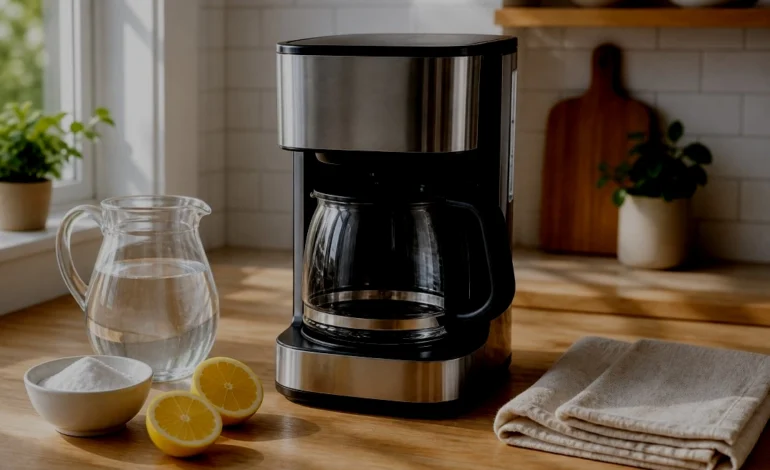
The first time I cleaned my coffee maker, I used vinegar. Everyone told me to. I filled the water tank with half vinegar and half water, pressed start, and let it run. Then I rinsed it twice, like the internet said.
The next morning, my coffee tasted like a salad. I could smell the vinegar before the coffee even hit my mug. I dumped the whole pot in the sink and started over.
That was the day I stopped using vinegar. Not because it does not work — it does. I stopped because of the smell, the taste it leaves behind, and one hard lesson I learned the expensive way: vinegar can be rough on the rubber seals and metal parts inside some coffee makers.
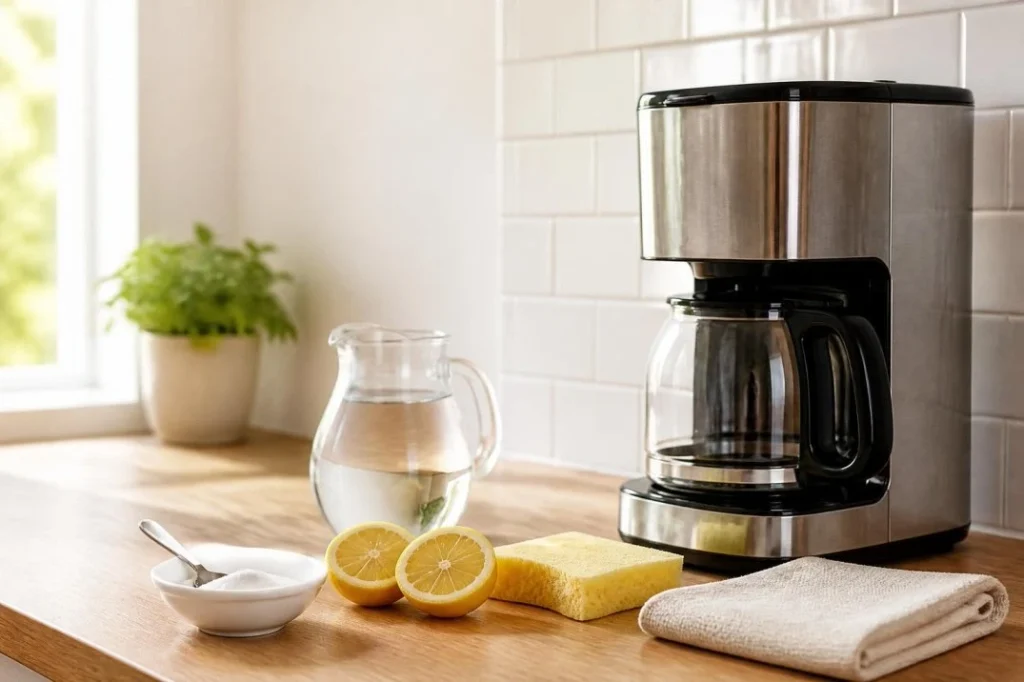
So I went looking for something better. I tried baking soda. I tried lemon. I tried a few other things from my own kitchen cabinet. Some worked great. One was a total waste of an afternoon.
This guide is what I ended up with. It is the exact method I use now, and it takes about 20 minutes. You do not need vinegar, and you do not need to buy anything fancy. Everything in this guide is already sitting in your kitchen or costs a couple of dollars at the grocery store.
Quick Answer:
How to clean a coffee maker without vinegar: Mix two tablespoons of baking soda into a full tank of warm water. Pour it in, run a full brew cycle, then let it sit for 15 minutes. Run one more cycle with plain water, then a second plain water cycle to rinse. Wash the carafe, filter basket, and lid with warm soapy water. For hard water stains, add half a cup of lemon juice or a spoon of citric acid to the water. Total time: about 20 to 30 minutes.
Why Clean Your Coffee Maker Without Vinegar?
Vinegar is not a bad cleaner. It breaks down hard water buildup, and it is cheap. Millions of people use it every day and are perfectly happy. But there are real reasons to skip it, and they are the reasons I did.
The smell hangs around. Vinegar has a sharp smell that does not leave quickly. Even after two rinse cycles, I could still catch it.
It can leave a taste. The acid in vinegar bonds to the plastic and rubber parts inside a coffee maker, and those parts hold onto smells. That is why my first cup tasted like a salad.
It is harsh on some parts. Used often, vinegar can dry out rubber gaskets and seals. A dried-out seal leaks, and a leaking coffee maker is a dead coffee maker.
Some makers say no. A lot of manuals tell you not to use vinegar because it can damage the finish. If your machine is still under warranty, that matters.
You already have better options. Baking soda, lemon juice, and citric acid do the same job without the smell or the risk. That is the whole point of this guide.
What You Need Before You Start
You do not need much. Here is my full list:
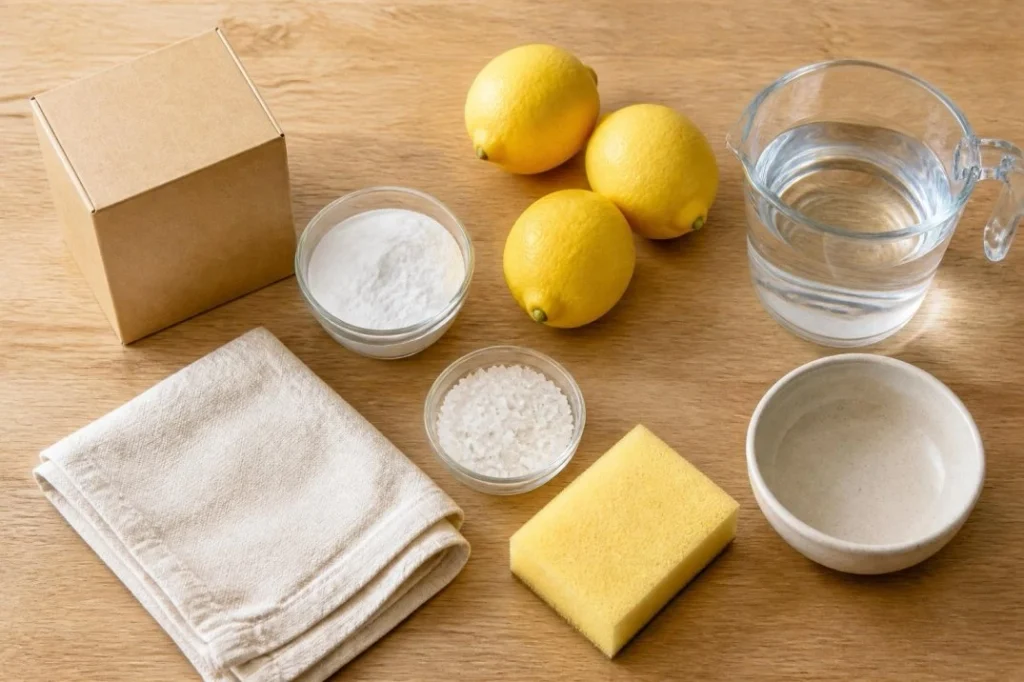
- Baking soda. The star of this guide. It lifts coffee oils and kills smells without leaving any scent behind.
- Warm water. Warm, not boiling. Boiling water can crack a cold glass carafe.
- Lemons or bottled lemon juice. For hard water stains and that white chalky film.
- Citric acid powder (optional). If your water is very hard, this works even better than lemon. You can find it in the canning aisle.
- A soft sponge or bottle brush. Soft is the key word. Never use steel wool.
- Mild dish soap. Regular dish soap, nothing with bleach.
- A clean towel and a bowl. For drying parts and holding the wet ones while you work.
One warning before we start: never mix baking soda and lemon juice in a closed container. They fizz hard. In an open bowl it is fine. Sealed up, it will pop the lid.
4 Best Vinegar-Free Cleaners
These are the 4 I have tested, ranked by how often I actually use them.
| Cleaner | Best for | How to use it | My rating |
| Baking soda | Coffee oils, smells, general cleaning | 2 tablespoons in a full tank of warm water | Best all-rounder |
| Lemon juice | Hard water stains, white film | 1/2 cup in a full tank of water | Great for buildup |
| Citric acid | Very hard water, heavy scale | 1 tablespoon in a full tank of warm water | Strongest descale |
| Dish soap and warm water | Carafe, basket, lid, gaskets | A few drops in warm water, wash by hand | Every single time |
Baking soda is my everyday choice. It is cheap, gentle, and leaves nothing behind. If your coffee tastes flat even with fresh beans, start here.
Lemon juice is my heavy hitter. That white, chalky film inside your carafe is hard water scale, and lemon eats right through it. Bottled juice works as well as fresh and saves you the squeezing.
Citric acid is the big gun for very hard water. A little goes a long way, so start small.
Dish soap and warm water is not glamorous, but it is the step most people skip. Coffee oils build up on the carafe, basket, and lid every day. Soap handles those, while the other three handle the inside of the machine.
How to Clean a Drip Coffee Maker Without Vinegar: Step by Step
This is the full method. From start to finish, it takes me about 25 minutes, and most of that is waiting.
Step 1: Unplug the Machine and Let It Cool
Unplug the coffee maker first. Always. Water and electricity do not mix, and a hot heating plate can crack a cold carafe.
Then let it cool for at least 10 minutes. If the machine still feels warm, wait longer. While you wait, take out the carafe, the filter basket, and the lid.
Step 2: Wash the Loose Parts by Hand
Fill your sink with warm water and a few drops of dish soap.
Wash the carafe, the filter basket, the basket cover, and the lid with a soft sponge. If your carafe has a narrow neck, a bottle brush reaches the corners a sponge cannot.
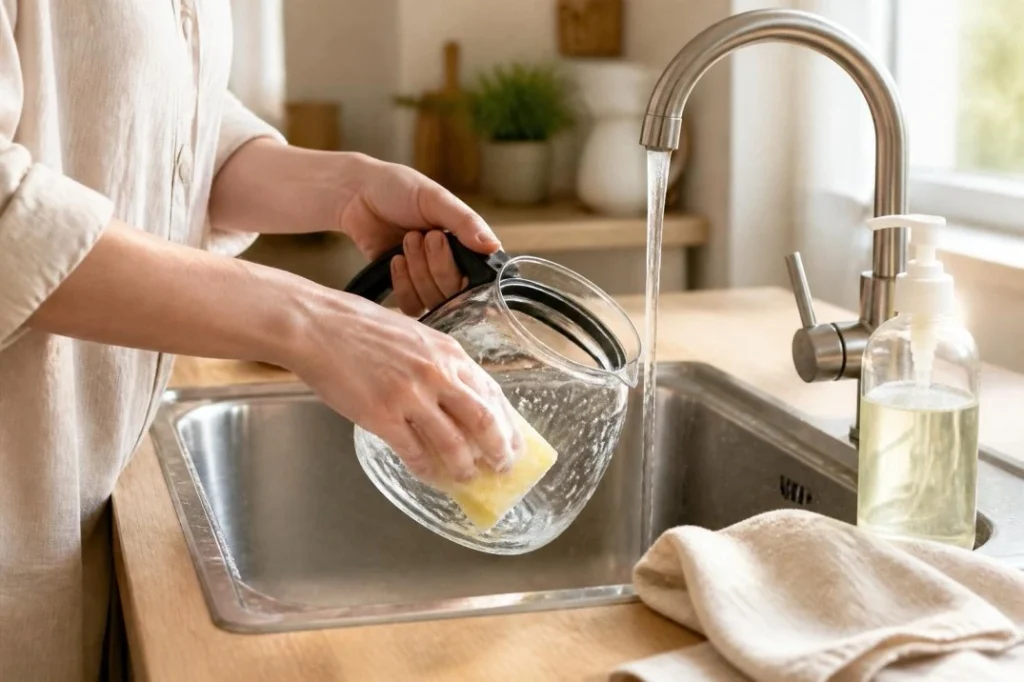
Five minutes with soap and a soft sponge. This is the step that makes the biggest difference day to day.
Pay extra attention to the lid and the little rubber gasket inside it. That gasket is where old coffee hides. If it comes out, wash it on both sides. If it does not come out, wipe around it with a sponge.
Rinse everything well and set it on a clean towel.
Step 3: Mix Your Baking Soda Solution
Now for the inside of the machine.
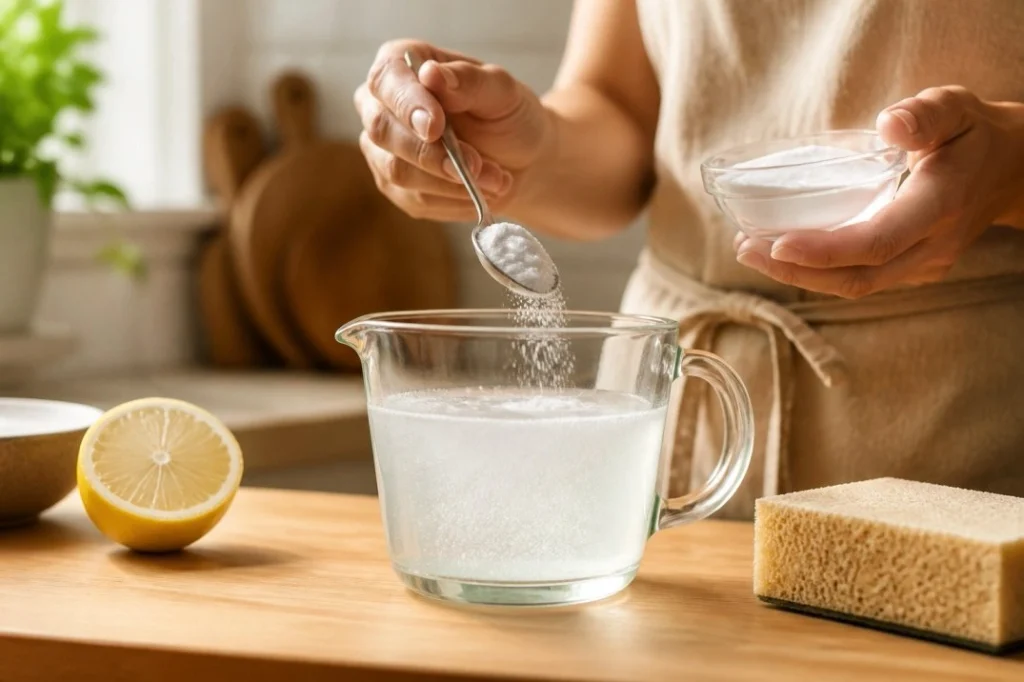
Add two tablespoons of baking soda to the water tank, then fill the tank with warm water up to the top line. Stir gently so the powder dissolves. It will fizz a little, which is normal.
If your machine has a removable reservoir, mix the solution in a measuring cup first and pour it in. That is what I do, because it mixes better. Use the full tank. A half tank does not clean the top half of the machine.
Step 4: Run a Full Brew Cycle
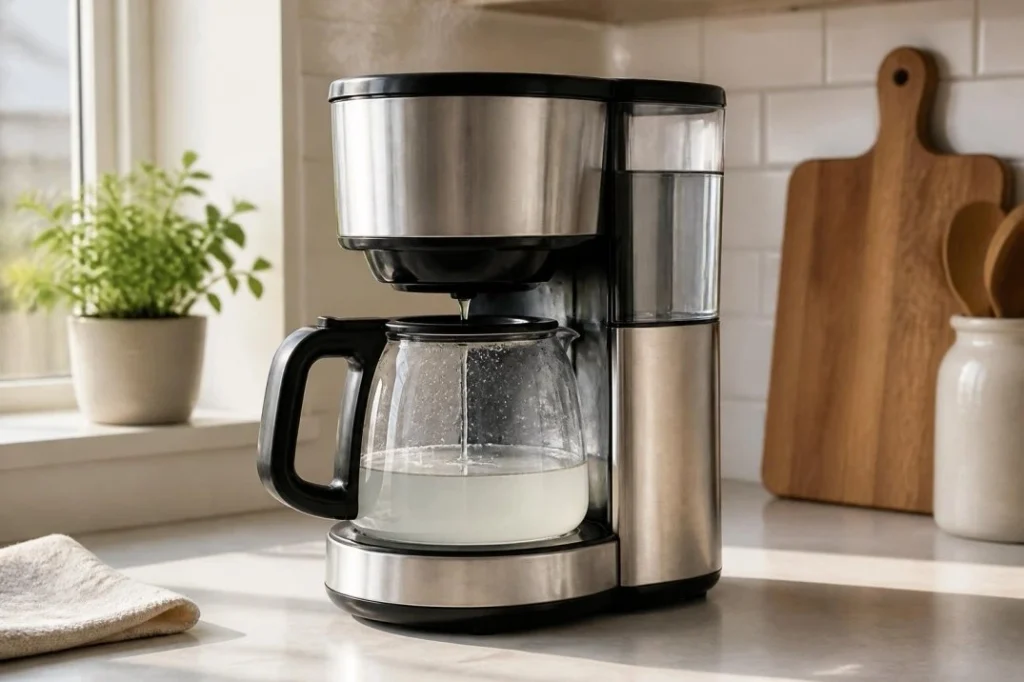
Set the empty carafe in place and press start. Let the whole tank brew through.
Set the empty carafe in place and press start. Let the whole tank brew through.
What comes out will look cloudy and slightly grey. That is old coffee oil and built-up scale leaving the machine. Do not panic. That is exactly what you want to see.
Some people dump the first cup and keep the rest. Either way, dump the whole carafe when the cycle ends.
Step 5: Let It Sit for 15 Minutes
This is the step everyone skips, and it is the one that matters most.
With the machine still warm, pour the hot baking soda water back into the water tank and let it sit for 15 minutes. The warmth opens up the inside parts, and the baking soda gets to work on the oils.
If your machine has a lot of buildup, leave it for 30 minutes. If it has been a year or more, leave it for an hour. It cannot hurt anything. Then dump it out and rinse the tank with plain water.
Step 6: Run Two Plain Water Cycles
Fill the tank with plain water and run a full cycle. Dump it. Then do it again with fresh water.
Two rinse cycles is the minimum. If you still smell anything, run a third. You want the water coming out to look and smell completely clear.
Step 7: Tackle Any Hard Water Stains
Now look at the inside of your carafe. See that white, cloudy film near the bottom? That is hard water scale, and soap will not touch it.
Here is my fix. Pour half a cup of lemon juice into the carafe and fill it the rest of the way with warm water. Let it sit for 20 minutes, then wipe it out with a soft sponge.
For heavy scale, use a tablespoon of citric acid powder in a full carafe of warm water instead. Let it sit for 30 minutes, then rinse very well. If the film is on the outside of the carafe, rub it with a lemon half dipped in a little salt. It sounds strange, but it takes about a minute and it works.
Step 8: Dry Everything and Reassemble
Dry every part with a clean towel, or let them air dry on a rack. Do not put wet parts back in the machine.
Put the basket, the lid, and the carafe back, then plug the machine in. Brew one small pot and pour the first cup down the drain if you want to be extra careful. I usually just drink it. By now the machine smells like nothing at all, and that is the point.
How to Clean a Keurig or Single-Serve Machine Without Vinegar
Single-serve machines need the same care, but the steps are a little different because you cannot see inside them.
- Unplug the machine and let it cool.
- Take out the water reservoir, the drip tray, and the pod holder, and wash them with warm soapy water. Rinse well.
- Fill the reservoir with warm water and one tablespoon of baking soda. Stir until it dissolves.
- Run several brews with no pod until the reservoir is empty, then refill with plain water and run three or four more to rinse.
- For a deep clean, use citric acid instead of baking soda, then rinse with at least four plain brews.
- Wipe the outside and the needle area with a damp cloth. Never poke anything sharp into the needle.
Most makers recommend descaling every 3-6 months. If your coffee starts tasting weak or the machine runs slow, do it sooner.
How Often Should You Clean Your Coffee Maker?
This is the schedule I actually follow. It took me a few years to land on it.
| Task | How often | Time it takes |
| Rinse the carafe and basket | Every day | 1 minute |
| Wash the carafe, basket, and lid with soap | Every week | 5 minutes |
| Deep clean the inside of the machine | Every month | 25 minutes |
| Descale for hard water (lemon or citric acid) | Every 1 to 3 months | 40 minutes |
| Clean a single-serve machine | Every 2 to 3 months | 30 minutes |
If you drink several pots a day, move everything up one step. If you use your coffee maker once a week, you can stretch it out a bit. And if your water is very hard, descale on the shorter end of that range. Hard water is the number one killer of coffee makers, and you cannot see the damage until it is done.
5 Mistakes I Made So You Do Not Have To
I made every mistake on this list. Some of them twice.
1. I poured boiling water into a cold carafe. The glass cracked in my hand. Warm water only, and let the carafe sit for a minute before you pour anything hot into it.
2. I skipped the rinse cycles. After my first baking soda clean, I rinsed once and brewed coffee. It tasted like salty bread. Two full plain water cycles is the rule, three if you are unsure.
3. I scrubbed with steel wool. I wanted that white film gone fast. What I got was a carafe full of fine scratches that trap stains even worse now. Soft sponge, that’s it.
4. I forgot the lid and the gasket. I cleaned the machine perfectly and still had a stale taste. The rubber gasket inside the lid was black with old coffee. Now I wash it every week.
5. I cleaned it right before a party. I ran the deep clean an hour before guests came, and my first pot was still a little off. Clean the machine at night, then brew fresh in the morning.
How to Keep Your Coffee Maker Clean Between Deep Cleans
A few small habits stretch the time between deep cleans, and they take almost no effort.
- Pour out the old coffee as soon as you are done. Never leave it in the carafe overnight.
- Rinse the carafe and basket with warm water after every pot.
- Leave the lid open so the inside can dry. Moisture is what grows that sour smell.
- Use filtered water if your tap water is hard. It costs a little more and saves you a lot of descaling.
Frequently Asked Questions
Can I really clean a coffee maker without vinegar?
Yes. Baking soda, lemon juice, and citric acid all break down coffee oils and hard water buildup. Baking soda handles smells and oils, while lemon and citric acid handle rock-hard scale.
What can I use instead of vinegar to clean a coffee maker?
Baking soda is the easiest swap. Mix two tablespoons into a full tank of warm water and run a brew cycle. For hard water, use half a cup of lemon juice or one tablespoon of citric acid instead.
Does baking soda damage a coffee maker?
No. It is gentle and does not attack rubber seals or metal parts the way acid can, which makes it the safest of the three for regular use.
Will lemon juice hurt my coffee maker?
In the small amounts used here, no. It is an acid, though, so do not use it every week, and always run two plain water cycles after. Use it for descaling, not routine cleaning.
How do I get the white film out of my carafe?
That film is hard water scale. Soak the carafe in half a cup of lemon juice and warm water for 20 minutes, then wipe it with a soft sponge. Use citric acid powder for very heavy scale.
How often should I clean my coffee maker?
Rinse daily, wash the parts with soap weekly, deep clean the inside once a month, and descale every 1-3 months.
My machine still smells after cleaning. What now?
Run one more cycle with plain water and a tablespoon of baking soda, then rinse twice. If the smell comes from the lid, the fix is the rubber gasket. Take it out, wash both sides, and let it dry fully before you put it back.
About This Guide
How I tested it
Every step here was tested on my own kitchen counter, with a standard drip coffee maker, a single-serve machine, and water from my own tap. I ran more than a dozen cleaning cycles while writing this, testing baking soda at different strengths, lemon juice, citric acid, and plain dish soap. I even cracked a carafe on purpose to see what boiling water would do. It did exactly what I expected.
Why I trust this Method
This is not a theory. It is what I do in my own kitchen every month, and it fixed my vinegary coffee problem for good. Everything here uses items you probably already own.
Final Thoughts
Learning how to clean a coffee maker without vinegar is easier than most people think. Mix baking soda into warm water, run a brew cycle, let it sit for 15 minutes, then rinse with plain water twice. Wash the carafe and basket with soap, and use lemon or citric acid for hard water stains. That is the whole job, and it takes about half an hour.
The best part is what you get back. No salad-smelling kitchen, no stale taste in your first cup, and no risk to the seals inside your machine. Just clean, fresh coffee made with things you already own.
So skip the vinegar. Grab the baking soda, put the kettle on, and give your coffee maker the twenty minutes it has been waiting for.
Must Read : How to Prepare Coffee Using a French Press

My Name is William Johnson, an experienced coffee expert and writer dedicated to sharing battle-tested brewing guides. Every technique which I recommends is backed by years of personal experimentation and hands-on testing. I test every brew before I write every guide. Sharing practical, field-tested coffee guides, Coffee-Ratio & brewing techniques