Do Coffee Beans Have Caffeine? The Straight Answer
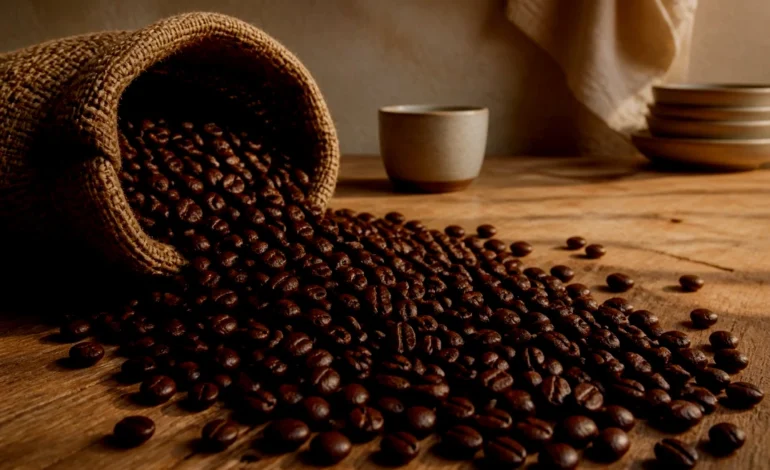
Every morning, millions of people in the United States grind up a small handful of hard, dark little seeds, pour hot water over them, and drink the result to feel awake. Most of us never stop to ask a simple question: how did the caffeine get in there in the first place?
The answer is more interesting than you might expect. Caffeine is not a coating on the bean. It is not something a factory sprays on at the end. It is a natural chemical that the coffee plant builds and stores inside its own seeds — the same way an apple tree builds sugar inside its fruit.
That one fact explains almost everything else in this article. Once you understand that the caffeine lives inside the bean itself, the rest falls into place: why green beans already have it, why roasting does not remove it, why decaf still has a trace, and why how many beans you use matters more than how dark they look.
Let’s walk through it step by step, in Simple language.
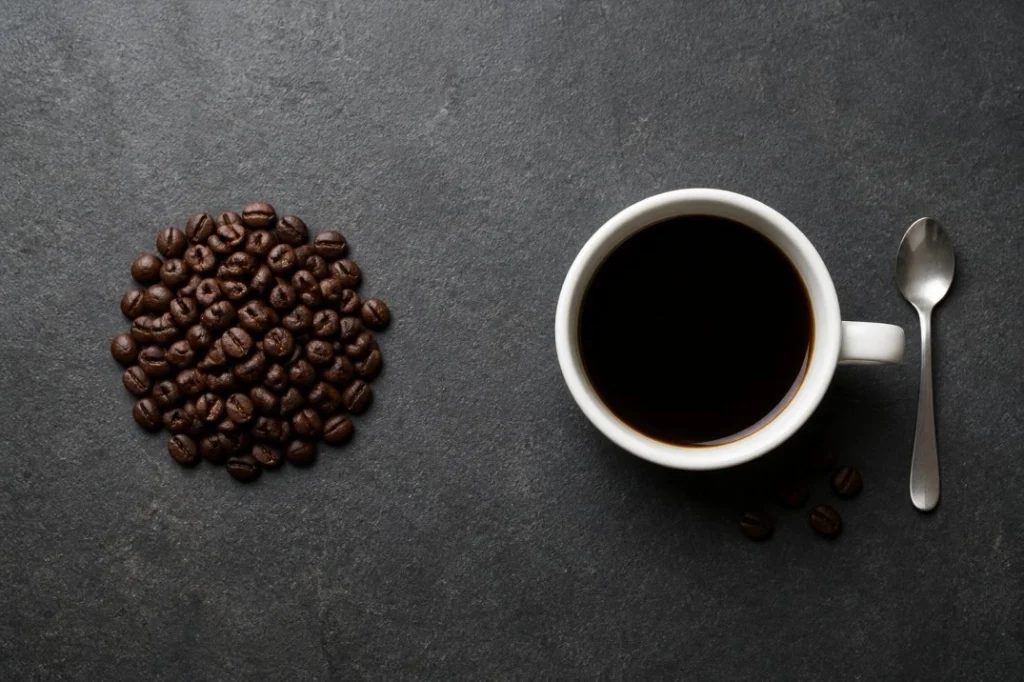
Do Coffee Beans Have Caffeine? The Short Answer
Yes. Every coffee bean has caffeine inside it — because the coffee plant puts it there on purpose.
Here is the simple truth: caffeine is not added to coffee. It grows inside the bean while the bean is still a seed sitting inside a coffee cherry. A green arabica bean is about 1.2% caffeine by weight. Robusta beans carry more, close to 2%. Roasting does not burn the caffeine away. And even decaf beans still hold a little.
So if you have ever wondered whether the beans themselves are the caffeine, the answer is yes. The beans are where it all starts.
Where Does the Caffeine in Coffee Beans Come From?
Coffee starts life as a fruit. The “bean” is not really a bean at all — it is the seed of a small red or yellow fruit called a coffee cherry. Those cherries grow on coffee trees, which belong to a plant group called Coffea. There are many kinds of coffee plants, but two of them supply almost all the coffee people drink in the U.S.: arabica and robusta.
Inside each cherry sit two seeds. Those seeds are what we roast, grind, and brew.
While the cherry is still hanging on the tree, the plant makes caffeine and stores it in the seeds. Why would a plant bother? Because caffeine is a built-in defense. It tastes bitter, which puts off animals that might eat the seeds. It can also slow down or harm insects that try to feed on the plant. In short, caffeine is part of how the coffee plant survives long enough to spread its seeds.
That is the key point: the caffeine is already there before any human touches the bean.
A farmer picks the cherries, removes the fruit around the seeds, then washes and dries the seeds. At that stage they are called green coffee beans — raw, pale, and grassy-smelling. They have not been roasted yet. And they are already loaded with caffeine.
This matters because a lot of people assume that caffeine is created during roasting. It is not. Roasting changes the flavor, the color, and the smell. It does not create the caffeine and it does not remove it. The caffeine was there from day one.
How Much Caffeine Is in a Coffee Bean? Arabica vs. Robusta
If you want to know how much caffeine is in a coffee bean, the first thing that matters is the type of bean, not the roast. This is the part most people get wrong.
Research on coffee brews shows that arabica green beans hold about 0.9% to 1.5% caffeine by weight, while robusta green beans run from about 1.2% to 2.4%. In plain terms, robusta beans carry roughly double what arabica beans do.
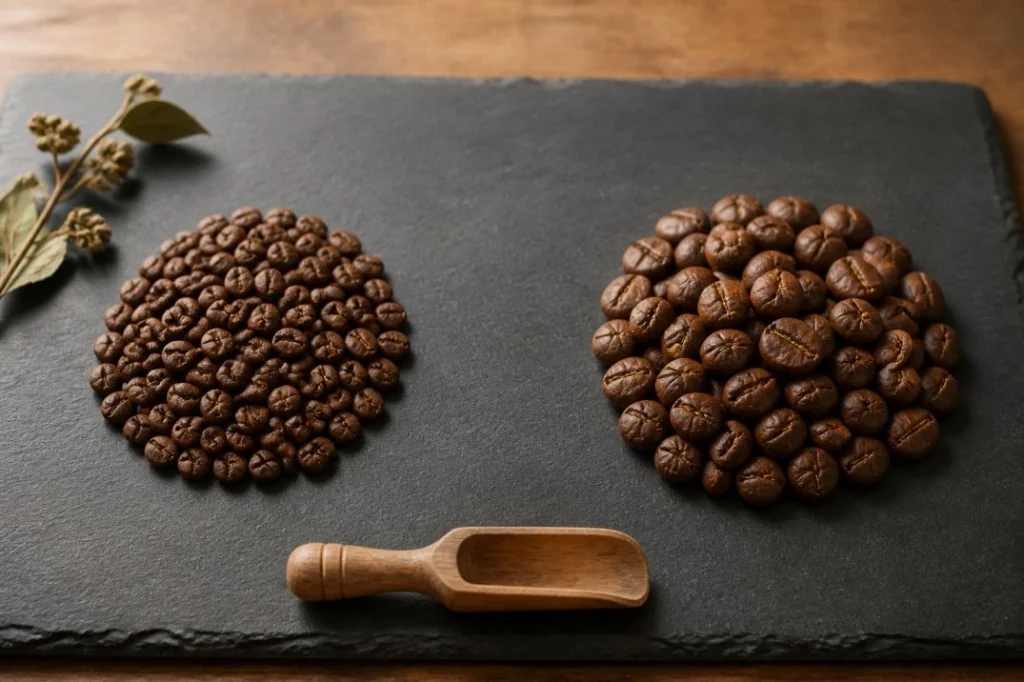
| Bean type | Caffeine in the green bean | What it means for you |
| Arabica | About 0.9% to 1.5% by weight | The milder, more popular type. Most specialty and single-origin coffee is arabica. |
| Robusta | About 1.2% to 2.4% by weight | Rounder, stronger, and more bitter. Common in instant coffee and many espresso blends. |
So a bean is not just “a bean.” The species matters a lot. If you switch from an arabica blend to a robusta-heavy blend and keep everything else the same, you may feel a real difference in how wired you get.
How much caffeine is in one single bean?
This is the question people search for most, and the honest answer is that it depends on the size of the bean. Here is the simple math, using the numbers above.
A single roasted coffee bean weighs only a tiny fraction of a gram. When you apply the caffeine percentages from the research, one arabica bean works out to roughly 1 to 2 milligrams of caffeine, and a robusta bean comes in at roughly double that.
That sounds small — and it is. It is why you need a whole scoop of beans, not one, to fill your mug. Chewing a single bean will not do much for you. But chew five or six and you have taken in a real dose, especially if they are robusta.
Do Green Coffee Beans Have Caffeine?
Yes, and this surprises a lot of people. Green coffee beans — the raw, unroasted seeds — have caffeine in them. In fact, they have essentially the same caffeine as the roasted beans you buy at the store.
You may have seen green coffee bean supplements sold online. Those products exist precisely because the caffeine (and other natural compounds) is already present in the raw seed. The raw bean does not need any processing to contain caffeine.
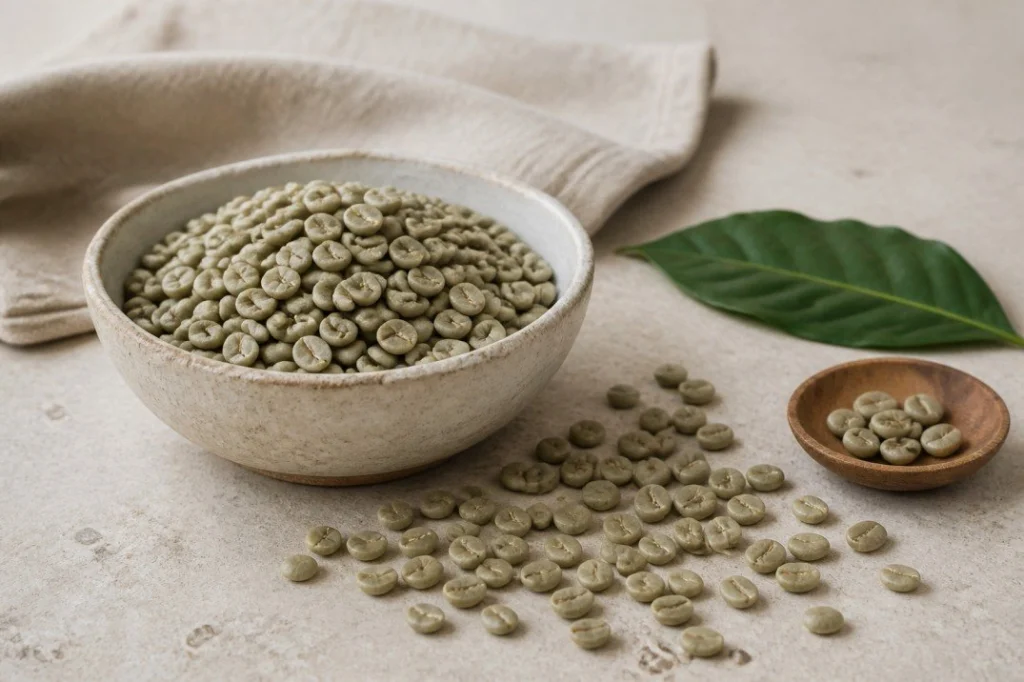
The reason this detail matters is that it settles the “does roasting burn off the caffeine” question before we even get to it. If the caffeine is in the raw seed, and roasting does not destroy it, then the caffeine is in your bag of beans no matter how they were roasted.
Does Roasting Remove Caffeine from Coffee Beans?
This is the most common myth about coffee, and it is worth clearing up carefully because it changes how you shop.
Roasting does not remove caffeine from coffee beans. Caffeine is a tough molecule. It holds up well under heat, and it remains stable at the temperatures used in a coffee roaster. Light roasts are usually roasted at around 350°F to 400°F, and dark roasts go a bit hotter and stay in the drum longer. Those temperatures are not enough to break caffeine down.
So where does the “dark roast has less caffeine” idea come from? There is a small grain of truth in it, and it is easy to understand once you see the whole picture.
As beans roast, they lose water. That is why dark roast beans look puffy and feel light, while light roast beans feel dense and heavy. Because water is leaving and the bean structure is changing, the caffeine measured by weight can shift slightly. Some studies do find that dark roasts come out a touch lower. For example, one study compared brewed samples and found about 60 mg of caffeine in a light roast and about 51 mg in the same amount of dark roast.
But here is the part that matters most: researchers generally describe that difference as small, and it mostly disappears when you measure your coffee by weight instead of by volume. In other words, if you put your beans on a scale, light and dark roast give you almost the same caffeine. If you scoop them with a tablespoon, you are comparing two different amounts of coffee — because a scoop of puffy dark roast weighs less than a scoop of dense light roast.
The practical takeaway: if you want less caffeine, changing the roast will not do much for you. Changing how much coffee you use, and which bean species you buy, will do far more.
Do Decaf Coffee Beans Have Caffeine?
Yes — decaf beans still have caffeine in them. This is not a trick or a labeling loophole. It is simply how the process works.
To make decaf, coffee companies take green coffee beans and remove most of the caffeine before roasting. There are a few common ways to do it. Some methods use chemical solvents such as methylene chloride or ethyl acetate. Others use carbon dioxide gas, or water-based methods. In each case, the beans are softened or soaked first, so the caffeine can be pulled out, and then they are dried again. The solvents bind to the caffeine and are rinsed or evaporated away.
By U.S. rules, at least 97% of the caffeine must be removed for coffee to carry the “decaffeinated” label. That is a lot — but “at least 97%” is not the same as 100%.
So how much is left? According to the U.S. Food and Drug Administration, decaf coffee typically has 2 to 15 milligrams of caffeine in an 8-ounce cup. That is a big drop from the roughly 95 mg in a regular cup, but it is not zero.
The FDA puts it plainly: “Decaffeinated” does not mean caffeine-free. If you are very sensitive to caffeine, or if a doctor has told you to avoid it, decaf may not be safe for you. That is worth knowing before you order a decaf after dinner and wonder why you are still awake at midnight.
From Bean to Cup: How Much Caffeine Actually Reaches Your Mug
Here is where the numbers get real. The bean decides how much caffeine is available. Your brewing method decides how much of it actually ends up in your cup.
Think of it this way. Your ground coffee holds a certain amount of caffeine. Hot water can only pull out so much of it, and how much it pulls out depends on how hot the water is, how long it touches the grounds, how fine the grind is, and how much coffee you used in the first place.
| What you drink | Caffeine | Source |
| 8 oz brewed coffee | About 95 mg | Harvard T.H. Chan School of Public Health |
| A 12 oz cup of coffee | Roughly 130 to 200 mg | FDA (400 mg is about two to three 12 oz cups) |
| 8 oz decaf coffee | 2 to 15 mg | FDA |
| 1 arabica bean | Roughly 1 to 2 mg | Estimated from published caffeine percentages |
| 1 robusta bean | Roughly 2 to 4 mg | Estimated from published caffeine percentages |
A few things to notice in that table.
First, the gap between regular and decaf is huge. A regular cup can have more than 45 times the caffeine of a decaf cup.
Second, cup size matters more than most people realize. A large coffee-shop cup is not one serving in caffeine terms. It can easily be two.
Third, a single bean really is a tiny dose. The caffeine that wakes you up is the sum of many beans, brewed together.
What This Means for Your Cup
Now that we know the caffeine comes from the bean, here is how to actually use that information
Do not pick your roast based on caffeine. If you are trying to cut back, switching from dark to light roast will not help in any meaningful way. Measure your coffee by weight and adjust how much you use instead.
Check which species you are drinking. Robusta has about twice the caffeine of arabica. If a blend suddenly feels stronger, the species mix may have changed. This is one reason some espresso blends kick harder than others — many of them include robusta for body and crema.
Weigh your coffee instead of scooping. A kitchen scale removes all the guesswork. It also fixes the light-versus-dark roast confusion, because you are comparing equal amounts of coffee rather than equal volumes.
Watch your total, not just your coffee. Caffeine shows up in tea, chocolate, cola, energy drinks, some protein bars, ice cream, chewing gum, and even some over-the-counter pain relievers. The FDA points out that your body handles added caffeine the same way it handles the caffeine that occurs naturally in coffee. So if you are tracking your intake, track all of it, not just the mug.
Know the daily guideline. For most healthy adults, the FDA cites 400 milligrams a day as an amount not generally linked with negative effects. The Mayo Clinic gives the same number and compares it to about four cups of brewed coffee. Keep in mind that this is a general guideline for healthy adults — how sensitive you are varies from person to person, and depends on things like your body weight, your medications, and your medical conditions.
Common Questions About Caffeine in Coffee Beans
Are coffee beans edible?
Are coffee beans edible?
Yes, roasted coffee beans are edible. People eat them as a snack, and chocolate-covered coffee beans are a popular treat. Just remember that each one carries caffeine, so a handful adds up faster than you might think.
Does chewing a coffee bean give you energy?
A little. One bean holds only a small amount of caffeine, so a single bean is unlikely to do much. Chewing several beans can add up, though the caffeine absorbs more slowly than it does from a drink.
Do darker roast beans have less caffeine?
Slightly, in some studies — but not enough to matter for most people. When coffee is measured by weight, light and dark roasts come out very close. Choose your roast because you like how it tastes.
Which has more caffeine, arabica or robusta?
Robusta. It contains roughly twice the caffeine of arabica, along with a stronger, more bitter flavor. Arabica is milder and is the more common choice in specialty coffee.
Is Instant coffee made from coffee beans?
Yes. Instant coffee is made from brewed coffee that has been dried into powder or granules, and that coffee was brewed from real coffee beans. That means it has caffeine too, and the amount varies by brand and by how much you use.
Does decaf coffee have zero caffeine?
No. Under U.S. rules, at least 97% of the caffeine has to be removed for coffee to be labeled decaffeinated. What is left is usually 2 to 15 milligrams per 8-ounce cup, compared with about 95 milligrams in a regular cup.
How We Researched This Article
We do not guess at numbers, and we do not repeat claims just because they are popular online. Here is how this guide was put together:
- Hands-on testing. We brew at home and in the shop, weigh beans on a scale, and compare cups side by side so the advice reflects real kitchen experience, not just theory.
- Primary sources first. Every number in this article traces back to a government agency, a university, or a peer-reviewed study — the FDA, Mayo Clinic, Harvard T.H. Chan School of Public Health, the USDA, the NIH, and the Specialty Coffee Association.
- Estimates are labeled as estimates. The per-bean caffeine figures are clearly marked as calculated from published caffeine percentages, because a single bean varies in size. We would rather show you the math than pretend to a false precision.
- We correct mistakes. If you spot an error, tell us and we will fix it and note the change.
Related Article : Can Decaf Coffee Keep You Awake?
1 Comment
[…] Related Article : Do Coffee Beans Have Caffeine? […]